
Showing posts with label Holly Rothrock. Show all posts
Showing posts with label Holly Rothrock. Show all posts
Monday, May 2, 2011
vignette final
All year I've been waiting to do a shop scene and here it is. I really like how this turned overall, especially the colors. It's nice too to see all our semesters' work come together into an illustration.


Monday, April 25, 2011

Sunday, April 17, 2011

Friday, April 8, 2011
15x2 silhouettes
15 is a lot more than I thought. And I think I'm slower using this method.
So here are the two village heads of each of my villages. I thought this would be a good exercise for me to define the similarities and differences of the two cultures.
These are the mountain bears. I tried a few different ideas, is he OR she a hands on leader who always has extra lights and pickaxes with him or her... or are they just crazy-old and wise? The village was built on its gem and ore reserves (not really it was built on rock haha), so I'm guessing necklaces are a class marker.

And here are those silly bears who live on top the mountain in the snow. I tried to give them a more tribal look - survival's no. 1 priority! So they have lots of layers and are mostly covered from head to toe. I played with the idea of a shamanic leader type or maybe a big strong Russian dude.

So here are the two village heads of each of my villages. I thought this would be a good exercise for me to define the similarities and differences of the two cultures.
These are the mountain bears. I tried a few different ideas, is he OR she a hands on leader who always has extra lights and pickaxes with him or her... or are they just crazy-old and wise? The village was built on its gem and ore reserves (not really it was built on rock haha), so I'm guessing necklaces are a class marker.

And here are those silly bears who live on top the mountain in the snow. I tried to give them a more tribal look - survival's no. 1 priority! So they have lots of layers and are mostly covered from head to toe. I played with the idea of a shamanic leader type or maybe a big strong Russian dude.

Saturday, April 2, 2011

Thursday, March 31, 2011


Wednesday, March 23, 2011
20 character sketches with some fauna yo
Ref sheets, character silhouettes and sketches plus some weird creature sketches?


Sunday, March 20, 2011


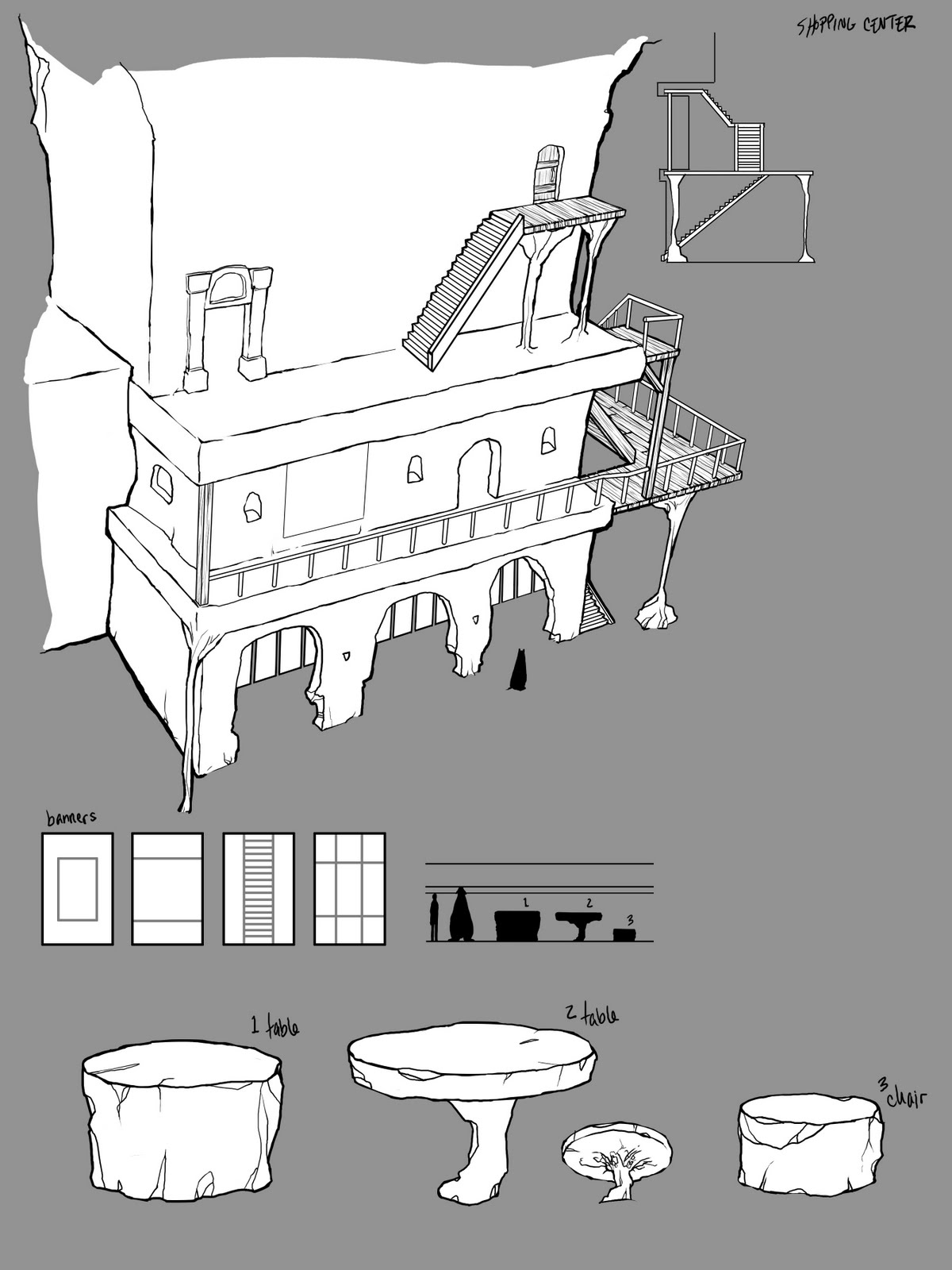
Monday, March 7, 2011
nook and cranny 2
My fixed environment

This week's environment

My half-finished third piece, I changed the composition a little and the perspective


This week's environment

My half-finished third piece, I changed the composition a little and the perspective

Sunday, February 27, 2011
first nook and cranny with a spaceship
My first nook and cranny finished environment plus my quick paintover of Zach's spaceship. I like to think of it as a small supply carrier in a time-sensitive atmosphere so it needs to be quick.


Monday, February 21, 2011


Monday, February 14, 2011
Environment and variations
Because the mountain town is completely encased by rock there really aren't that many variations in the atmosphere. Instead of mood lighting I played with the idea of different colored rock/lights.


Saturday, February 5, 2011
references and sketch
I struggled a lot with what environment would best describe my world and I settled on the town center of the underground city. As the city gets deeper and deeper into the mountain the pillar in the center gets taller and taller, scaling the whole height of the city. In the distance there is another pillar built for the town above ground, as a respect and to symbolize the co-existence of the two cultures. The top of this pillar was left untouched until the armistice.


Monday, January 31, 2011
Vinds-Hallr and Heilluhalla
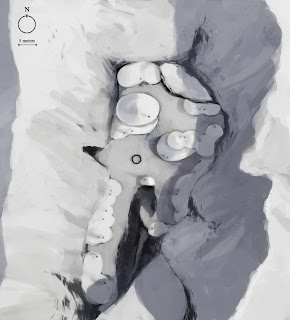
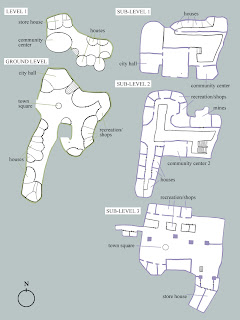
The two towns of Vinds-Hallr and Heilluhalla are built one on top the other so I thought that separating them into levels would be the most efficient way of depicting them. I kept the idea of "playable areas" in my head while drawing these, I'm not sure if it helped or hurt the design.
Synopsis can be found below.
Synopsis:
The landmass of Valdsey is largely made up of a steep mountain range to the west and a thin coast to the east with a small plain in between. There are small settlements sprinkled about the coast of the island with a larger kingdom to the northeast.
One can focus on a small village, the farthest inland, to spotlight. The only civilization for miles, the only one in the Kols mountain range, the town of Vinds-Hallr is special because of its deceptiveness. The town is in fact two towns, stacked on top of one another. Above ground is Vinds-Hallr, the surface-dwellers. They have braved the harsh wind and snow of their peaks and thrived. Below, shaped into the mountain itself, is Heilluhalla, the home of the mountain-dwellers. Their more hospitable location has allowed them to give their attention to the growth of their city.
Because of the similarity in the two peoples’ iconography, it can be assumed that they share a common history. Vinds-Hallr was the first town to blossom out of the snowy mountainside. The inhabitants, Mellr (bear-like creatures), sought freedom from the overbearing (haha, because they’re bears, get it?) taxation of the northern kingdom Regins-Ha. With impenetrable defense from the kingdom’s large army by its hostile mountain environment, Vinds-Hallr grew into a prosperous little town. Its growth was indebted to the trade routes with its otherwise isolated neighbors in the cliffs to the west, its main export being animal skins that prior to were extremely hard to come by. Unfortunately, civil unrest split the town. Some wanted to tunnel into the mountains for ore and better shelter. Others refused, Valdsey’s primary “religion” forbidding the devastation of the natural landscape. Civil war threatened the mountain-seekers’ new homes, yet with the risk of also destroying the promising Vinds-Hallr an armistice was called. Thus Heilluhalla was born.
A century passed and today the armistice is long forgotten, as well as most feelings of ill-will. Passage between the two villages is quite accessible to the common Mellr with a naturalization process both ways. One can tell the Vinds-Mellr from the Heilla-Mellr fairly easily because of the colorations and patterning of their fur, though “inter-racial” mating does exist. Both, however, have developed distinctly smaller ears than their coastal cousins.
Both towns are alike in that they each include town squares (the Vinds-Hallr center would be primarily used for religious ceremonies), a city hall, a community building, recreational spots, storage houses, shops, educational systems, and living quarters (individual and group). Since the war Vinds-Hallr has spread vastly, filling small passes and caves. Their main building materials are rock and wood and grass that is traded for. Their buildings are characterized by their functionality, low roofs, and air vents which allow the harsh mountain winds to safely pass through the structures. Vinds-Hallr’s main export is still animal skins. Heilluhalla, on the other hand, has grown downward, although artificial lakes for water collection had to be made ironically because of the city’s height above sea-level. Its buildings are carved directly from the natural rock of the mountain. Heilluhalla’s architecture is richly ornamented and the city has a small tourist trade beginning. Little trading is necessary for materials, but food is an important concern as the lack of agriculture makes animal herding virtually impossible. Observably, the mountain city’s main export is ore and precious stones.
Synopsis can be found below.


Synopsis:
The landmass of Valdsey is largely made up of a steep mountain range to the west and a thin coast to the east with a small plain in between. There are small settlements sprinkled about the coast of the island with a larger kingdom to the northeast.
One can focus on a small village, the farthest inland, to spotlight. The only civilization for miles, the only one in the Kols mountain range, the town of Vinds-Hallr is special because of its deceptiveness. The town is in fact two towns, stacked on top of one another. Above ground is Vinds-Hallr, the surface-dwellers. They have braved the harsh wind and snow of their peaks and thrived. Below, shaped into the mountain itself, is Heilluhalla, the home of the mountain-dwellers. Their more hospitable location has allowed them to give their attention to the growth of their city.
Because of the similarity in the two peoples’ iconography, it can be assumed that they share a common history. Vinds-Hallr was the first town to blossom out of the snowy mountainside. The inhabitants, Mellr (bear-like creatures), sought freedom from the overbearing (haha, because they’re bears, get it?) taxation of the northern kingdom Regins-Ha. With impenetrable defense from the kingdom’s large army by its hostile mountain environment, Vinds-Hallr grew into a prosperous little town. Its growth was indebted to the trade routes with its otherwise isolated neighbors in the cliffs to the west, its main export being animal skins that prior to were extremely hard to come by. Unfortunately, civil unrest split the town. Some wanted to tunnel into the mountains for ore and better shelter. Others refused, Valdsey’s primary “religion” forbidding the devastation of the natural landscape. Civil war threatened the mountain-seekers’ new homes, yet with the risk of also destroying the promising Vinds-Hallr an armistice was called. Thus Heilluhalla was born.
A century passed and today the armistice is long forgotten, as well as most feelings of ill-will. Passage between the two villages is quite accessible to the common Mellr with a naturalization process both ways. One can tell the Vinds-Mellr from the Heilla-Mellr fairly easily because of the colorations and patterning of their fur, though “inter-racial” mating does exist. Both, however, have developed distinctly smaller ears than their coastal cousins.
Both towns are alike in that they each include town squares (the Vinds-Hallr center would be primarily used for religious ceremonies), a city hall, a community building, recreational spots, storage houses, shops, educational systems, and living quarters (individual and group). Since the war Vinds-Hallr has spread vastly, filling small passes and caves. Their main building materials are rock and wood and grass that is traded for. Their buildings are characterized by their functionality, low roofs, and air vents which allow the harsh mountain winds to safely pass through the structures. Vinds-Hallr’s main export is still animal skins. Heilluhalla, on the other hand, has grown downward, although artificial lakes for water collection had to be made ironically because of the city’s height above sea-level. Its buildings are carved directly from the natural rock of the mountain. Heilluhalla’s architecture is richly ornamented and the city has a small tourist trade beginning. Little trading is necessary for materials, but food is an important concern as the lack of agriculture makes animal herding virtually impossible. Observably, the mountain city’s main export is ore and precious stones.
Subscribe to:
Posts (Atom)